Today was my first opportunity to use breastmilk medicinally. While it's a moment I haven't exactly been looking forward to because it means someone isn't 100% healthy, I find the anti-microbial properties amazing. Tye woke this morning with a slightly larger amount of mucus in her left eye. I made note of it, but didn't think much of it. A few hours later, her eyelid was pink and her eye was starting to look glassy. So, I squirted a little breastmilk in it. Tye didn't complain a bit- though after a few seconds of having my nipple in her face but not in her mouth, she was more than eager to nurse (and I learned that I need to practice my aim!).
After the nap following that feeding, Tye woke up with a completely clear eye. We squirted a second round of milk in her eye just for good measure. Ahh, the miracle of breastmilk.

Friday, April 9, 2010


Wednesday, April 7, 2010
What Co-sleeping Essay?
A few weeks ago, I entered a co-sleeping essay contest. The winners were to be published in a book, but the real draw was that one writer would win a Humanity Family Sleeper, the co-sleeping aide I've been eyeing. When I saw that prize, I threw together 300 words on co-sleeping and entered the contest, hoping with all my might that we'd win the Family Sleeper.
 Well, I won- but not the co-sleeper. My essay is one of six being published as chapter introductions in the book Are You Co-Sleeping? Me Too! Of the six given writing prompts, I wrote on how co-sleeping saved my child's life. Of course, I don't know for certain that co-sleeping ever saved Tye's life, but I hate to think what could have happened had she started her life at home sleeping in a crib.
Since she was just weeks old, Tye has had reflux-related choking episodes in which she struggles to clear the spit up from her airways. Some episodes are scarier than others, such as when she silently turned purple in my arms while I scrambled to find the bulb syringe. Others have been much less scary and Tye has cleared her airways herself, sometimes spitting milk out her nose- poor girl. These episodes usually occurred every few days and sometimes three or four times in one day, though they have become less frequent over the past month. For the first several weeks of her life, Tye slept on my chest at night, and later very close beside me. When she choked, her arms flailed, waking me if I wasn't already so that I could pick her up, hold her face-down, comfort her, and suction her throat if she needed assistance. While I'll never know for sure that Tye wouldn't have eventually cleared her throat herself all those times, it's something I'm quite grateful I never had to find out.
In timely fashion, I read an email from another mom on the Holistic Moms Network message board last week. The topic was babies sleeping on their backs and how important the "Back to Sleep" idea is. This mom shared the story of her son with reflux. While just days old in the hospital, asleep on his back in the nursery, he experienced choking related to reflux. Because he was on his back, he couldn't breathe and turned blue. Since then, he has been diagnosed as having cerebral palsy linked to oxygen deprivation those first days.
This mother's experience validated my own fears for Tye's well-being. I have wondered often if I have been overly concerned and wasting energy worrying about a remote possibility. Now I know that my fears were justified, and I'm thankful that I made all those choices to stay near Tye at all times and to never leave the house without a bulb syringe. I am forever grateful that we started co-sleeping and that I woke up every time Tye choked.
The co-sleeping essay I wrote concisely explained how I have woken up to Tye choking silently in the middle of the night and how I believe having Tye beside me at night has helped to keep her safe. It will introduce a chapter on the safety benefits of co-sleeping, and I'll receive a free copy of the book in a few weeks.
Maybe then I can share what I wrote with you, because I never saved my essay.
Well, I won- but not the co-sleeper. My essay is one of six being published as chapter introductions in the book Are You Co-Sleeping? Me Too! Of the six given writing prompts, I wrote on how co-sleeping saved my child's life. Of course, I don't know for certain that co-sleeping ever saved Tye's life, but I hate to think what could have happened had she started her life at home sleeping in a crib. Since she was just weeks old, Tye has had reflux-related choking episodes in which she struggles to clear the spit up from her airways. Some episodes are scarier than others, such as when she silently turned purple in my arms while I scrambled to find the bulb syringe. Others have been much less scary and Tye has cleared her airways herself, sometimes spitting milk out her nose- poor girl. These episodes usually occurred every few days and sometimes three or four times in one day, though they have become less frequent over the past month. For the first several weeks of her life, Tye slept on my chest at night, and later very close beside me. When she choked, her arms flailed, waking me if I wasn't already so that I could pick her up, hold her face-down, comfort her, and suction her throat if she needed assistance. While I'll never know for sure that Tye wouldn't have eventually cleared her throat herself all those times, it's something I'm quite grateful I never had to find out.
In timely fashion, I read an email from another mom on the Holistic Moms Network message board last week. The topic was babies sleeping on their backs and how important the "Back to Sleep" idea is. This mom shared the story of her son with reflux. While just days old in the hospital, asleep on his back in the nursery, he experienced choking related to reflux. Because he was on his back, he couldn't breathe and turned blue. Since then, he has been diagnosed as having cerebral palsy linked to oxygen deprivation those first days.
This mother's experience validated my own fears for Tye's well-being. I have wondered often if I have been overly concerned and wasting energy worrying about a remote possibility. Now I know that my fears were justified, and I'm thankful that I made all those choices to stay near Tye at all times and to never leave the house without a bulb syringe. I am forever grateful that we started co-sleeping and that I woke up every time Tye choked.
The co-sleeping essay I wrote concisely explained how I have woken up to Tye choking silently in the middle of the night and how I believe having Tye beside me at night has helped to keep her safe. It will introduce a chapter on the safety benefits of co-sleeping, and I'll receive a free copy of the book in a few weeks.
Maybe then I can share what I wrote with you, because I never saved my essay.
Tuesday, April 6, 2010
Eating like a gorilla
When I was pregnant, I was fascinated by the gestational periods of other animals (like the beluga whale at the Shedd Aquarium, who gave birth after 14.5 months!). Now, I am even more intrigued by mammal lactation in general. Mammals are named for the mammary glands that feed their young and allow for survival of each generation. Our mammaries are so special, so unique, so awesome that we are named for them. Even more than when I was pregnant, I feel like I have a great deal in common with lactating mothers of all species. Lactation is a natural phenomenon, like pregnancy, but nursing is an act of which the mother is keenly aware. It is something we mothers do to keep our young alive.
Gorillas nurse their young for three to four years. For the first five months of the baby gorilla's life, the mother and baby are never separated, even for a matter of seconds (Tye would still be completely attached to me, constantly; even as connected as we are, I find that hard to imagine!). By the age of 1, the young gorilla may wander as far away from its mama as 5 meters, but it still nurses at least once an hour (and I thought Tye nursed a lot!). By 18 to 24 months, the young gorilla wanders more frequently and nurses less frequently, about every two hours. Until the young gorilla weans at three or four years, it sleeps in the mother's nest.
photo from Awesome Gorillas, everwonder.com

Gorillas reach maturity at 15 years, signaled by males leaving the natal group. This long road to maturity makes gorillas fairly similar to humans in length of childhood. Of course, the gorilla's maternal behaviors protect their young from threats that human infants don't face, like males from outside the group and jaguars. But the care the mothers give provides more than just protection. Nursing their young provides nutrition for three to four years. If humans take at least 15 years to reach maturity, shouldn't we be nursing our young for just as long?
In case you were wondering, beluga whales nurse their young for two years. I wish the beluga and her calf at the Shedd were on exhibit. I would go with Tye and watch until she nursed, perhaps even nurse together. I'll never hear Baby Beluga again without imagining myself nursing alongside a beluga at the aquarium.
Gorillas nurse their young for three to four years. For the first five months of the baby gorilla's life, the mother and baby are never separated, even for a matter of seconds (Tye would still be completely attached to me, constantly; even as connected as we are, I find that hard to imagine!). By the age of 1, the young gorilla may wander as far away from its mama as 5 meters, but it still nurses at least once an hour (and I thought Tye nursed a lot!). By 18 to 24 months, the young gorilla wanders more frequently and nurses less frequently, about every two hours. Until the young gorilla weans at three or four years, it sleeps in the mother's nest.
photo from Awesome Gorillas, everwonder.com
Gorillas reach maturity at 15 years, signaled by males leaving the natal group. This long road to maturity makes gorillas fairly similar to humans in length of childhood. Of course, the gorilla's maternal behaviors protect their young from threats that human infants don't face, like males from outside the group and jaguars. But the care the mothers give provides more than just protection. Nursing their young provides nutrition for three to four years. If humans take at least 15 years to reach maturity, shouldn't we be nursing our young for just as long?
In case you were wondering, beluga whales nurse their young for two years. I wish the beluga and her calf at the Shedd were on exhibit. I would go with Tye and watch until she nursed, perhaps even nurse together. I'll never hear Baby Beluga again without imagining myself nursing alongside a beluga at the aquarium.
Monday, April 5, 2010
Swinging!
Today Tye and I went to the park with my friend Ines and her son Marquise, who is almost 7 months old and Tye's new best friend. Marquise, being the older man and all, had a little experience on the swings, but today was Tye's first time! She loved it right away.


The swings were big enough to fit both Tye and Marquise at the same time, so we put them in back to back. Even though I know neither realized there was a friend behind them, it was a perfect set up. Each babe got to swing facing his/her mom while Ines and I chatted... as much as possible while making googley faces at the kids. But really, how could we take our eyes off of this cuteness for even a second?


Friday, April 2, 2010
Friday Favorite- Baby mani/pedi tools
Before Tye was born, I bought a little kit that included all the "essential" baby care items, like a bulb syringe, digital thermometer, eyedropper, hairbrush (HA!), and nail clippers. Seriously, it should have been on all those babycenter.com "Baby gear I could have lived without" lists. Not one item has been used, but one did get an attempt- the baby nail clippers. I tried to use them, but they were so dull that they didn't cut Tye's soft baby finger nails. Useless. At least I didn't try the "Deluxe" version, in which a magnifying glass was added on to the useless clippers. I could see these being indispensable for someone with a vision impairment, but for the normal parent? Really?

When the baby nail clippers didn't work, I tried adult nail clippers, but they were so large that they completely dwarfed Tye's tiny fingers and made the task close to impossible. I finally found that sharp cuticle clippers work perfectly. They allow precision trimming with good visibility and comfortable maneuverability.
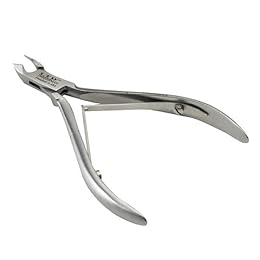
When the baby nail clippers didn't work, I tried adult nail clippers, but they were so large that they completely dwarfed Tye's tiny fingers and made the task close to impossible. I finally found that sharp cuticle clippers work perfectly. They allow precision trimming with good visibility and comfortable maneuverability.
Once we had the right tool established, the next struggle was encouraging Tye to sit still, or at least let us hold her hands and feet still. We could have tried trimming her nails while she was sleepy or asleep, but considering how poorly bathtime goes when she's sleepy, I thought perhaps it was best to find a time when she was awake and content. When she was a newborn, I could prop her up while she was nursing and clip her nails then. Nothing would separate her from the breast! I don't think she even noticed the trimming.
Now that she's older, though, she has less of an attention span for nursing, so I had to find something else. We rarely have the TV on with Tye around (at least during the week). When it is on, Tye stares at the screen with wide eyes, her eyes never leaving the moving images. Once, I tried clipping her nails while we sat in front of the TV, and it worked beautifully. Now, the only time Tye gets to "watch" TV is when her nails are being trimmed. What a lucky girl- a manicure and pedicure and TV time, all in one sitting!
Thursday, April 1, 2010
Summer weather

Tye's even wearing her Blondie onsie. What a hipster!
Chicago reached 83 degrees today, the warmest ever for April 1st- and that's no fooling, by the way. Tye and I celebrated with a really long walk with Mico this morning and a new pair of shades for her. We've been airing out our place, and the warm breeze is doing wonders replacing the stuffy indoor winter air. The air inside feels so much better now that it's fresh.
Subscribe to:
Posts (Atom)
LinkWithin
