Yesterday Etta had a three month checkup, and Tye came along. Etta is up to 12 pounds, 2 ounces, and Tye is a whopping 31 pounds!
Tye was so fascinated by the doctor's equipment that we stopped on the walk home to get her a play doctor's kit. Apparently, she did not pay attention when the doctor used the stethoscope.
Saturday, March 31, 2012
Friday, March 30, 2012
1 in 88
The CDC just updated their autism prevalence data to 1 in 88. ONE CHILD IN 88 HAS AUTISM. And because boys are five times more likely to be affected, ONE IN 54 BOYS HAS AUTISM.
Please, take a minute to think about that. Think not only about how many children will be diagnosed, but how many families will face that diagnosis.
And now look at the details of the information released. 1 in 88 is the statistic for children born in 2000. With the rate steading climbing- 1/150 born in 1994, 1/125 born in 1996, 1/110 born in 1998, and now 1/88 born in 2000. The most recent data is for children born 12 years ago. What will the statistics be for children born this year?
Autism is a life-long diagnosis. There is no cure. Yes, we know children make better academic gains with Early Intervention services including speech and occupational therapy, but we need to be doing more than putting 1 in 88 kids through extensive therapy for their entire educational careers and beyond. We need to be working proactively to prevent autism. If our children aren't enough of a reason, perhaps this is: the cost of autism in the US is an incredible $126 billion annually.
Preventing autism would require knowing the cause(s). We need unbiased research, funded and conducted by individuals without any connection to possible causes and with no personal gain at stake. According to awareness group Autism Speaks, "More children will be diagnosed with autism this year than with AIDS, diabetes & cancer combined." And yet, autism research receives just 0.6% of the total funding from the National Institute of Health, even though it affects one in 88 children and one in 54 boys.
As a teacher who worked with children with autism, I had an intense physical reaction to these new statistics. I was nauseated. Heartbroken. I loved my job and loved my students- challenges and all- and I look forward to moving forward in my career in Special Education. But I wish life was easier for children with autism. I wish I didn't have to hold back tears at every annual parent meeting when families were reminded of their child's special needs (and I wish it was okay for me to hug parents when they cried). I wish I was worried about job security.
As April begins this weekend, so does Autism Awareness Month. When you see blue lights as a part of the Light It Up Blue autism awareness campaign- everywhere from city skyscrapers to front porch lights- think about 1 in 88. Consider donating to Autism Speaks, the largest autism science and advocacy organization in the US. And please, talk about it. If any other disease was discovered to affect 1 in 88 children and was becoming more prevalent every year, it would be front page news. As parents, teachers, and citizens, let's at least make 1 in 88 a topic of conversation.
Thursday, March 29, 2012
Monday, March 26, 2012
Let's Pretend!
Watching Tye's development through the eyes of an Early Childhood Educator has been an amazing experience. With each new step, I'm thrilled, especially as I see her developing new play skills. You might remember my excitement when Tye started putting blocks into a bucket, reaching the second level of basic play.
Quite a few levels later, a child reaches imaginary play. First, a child uses actual objects to engage in pretend play. A perfect example is when Tye received a toy phone for her first birthday, opened the gift, and immediately held the phone up to her ear and said "Hello?"
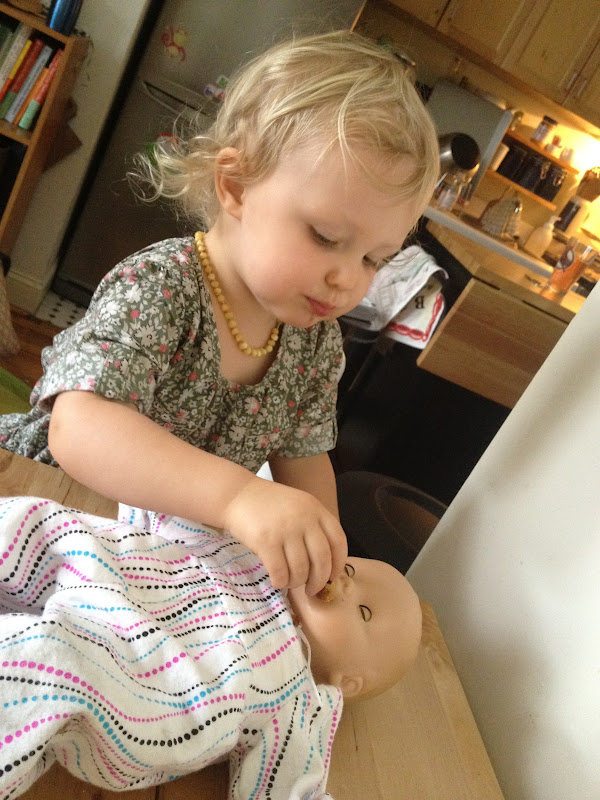
The next two stages of pretend play happen so close together that they often appear to evolve simultaneously. Technically first, a child uses a substitute object in place of an item in play- for example, when Tye held a remote control or block up to her ear and pretended to talk on the phone. Next, a child uses toys to engage with a pretend object, such as feeding a doll with a spoon. The subtle difference between these two is that in the first, the action is performed by the toddler and includes only the child and the toy; in the second, the action is aimed at a different recipient. Tye has been engaging in these two stages for quite a long time, though her playscapes have become more complicated as she has grown. Most recently, Tye gives her baby doll or animal feelings. Just yesterday, she told me, "Baby needs cookie. Baby's belly hurts. Baby's hungry. Eat some cookie, baby!" and later on, "Baby's sad. Baby needs na-nas," as she held her baby up to her breast to nurse her.
Right around her second birthday, Tye entered the next stage of pretend play by including imaginary objects in her play. It started with her pretending to hold a cup of coffee and asking me if I wanted some, too, then handing the imaginary cup to me. We still do this quite often with "coffee" and "cookies." This stage also includes running away from imaginary monsters, another one we do often, especially at the playground. The best part of this stage is that this type of play can take place with no toys and can therefore travel easily! Coffee party in the checkout line, anyone?
The next stage includes stringing together play into a series of events, such as pretending to drive to the zoo and then getting out to walk and see the animals. We are just reaching this stage, and I thoroughly enjoy listening to Tye engage in these more complicated scenarios.
Tye is also beginning to role play, yet another developmental level of play. In our house, it's not uncommon to hear Tye say, "Tye's a turtle!" or "Tye's a kitty!" We've also recently heard mouse, puppy, and an even more abstract concept, princess. During our visit to my parents' home, Tye first pretended she was a princess by wrapping my scarf around her shoulders and walking around slowly, regally, her chin held high.
She has come a long way from those first block-in-bucket days, hasn't she?
Quite a few levels later, a child reaches imaginary play. First, a child uses actual objects to engage in pretend play. A perfect example is when Tye received a toy phone for her first birthday, opened the gift, and immediately held the phone up to her ear and said "Hello?"
The next two stages of pretend play happen so close together that they often appear to evolve simultaneously. Technically first, a child uses a substitute object in place of an item in play- for example, when Tye held a remote control or block up to her ear and pretended to talk on the phone. Next, a child uses toys to engage with a pretend object, such as feeding a doll with a spoon. The subtle difference between these two is that in the first, the action is performed by the toddler and includes only the child and the toy; in the second, the action is aimed at a different recipient. Tye has been engaging in these two stages for quite a long time, though her playscapes have become more complicated as she has grown. Most recently, Tye gives her baby doll or animal feelings. Just yesterday, she told me, "Baby needs cookie. Baby's belly hurts. Baby's hungry. Eat some cookie, baby!" and later on, "Baby's sad. Baby needs na-nas," as she held her baby up to her breast to nurse her.
Right around her second birthday, Tye entered the next stage of pretend play by including imaginary objects in her play. It started with her pretending to hold a cup of coffee and asking me if I wanted some, too, then handing the imaginary cup to me. We still do this quite often with "coffee" and "cookies." This stage also includes running away from imaginary monsters, another one we do often, especially at the playground. The best part of this stage is that this type of play can take place with no toys and can therefore travel easily! Coffee party in the checkout line, anyone?
The next stage includes stringing together play into a series of events, such as pretending to drive to the zoo and then getting out to walk and see the animals. We are just reaching this stage, and I thoroughly enjoy listening to Tye engage in these more complicated scenarios.
Tye is also beginning to role play, yet another developmental level of play. In our house, it's not uncommon to hear Tye say, "Tye's a turtle!" or "Tye's a kitty!" We've also recently heard mouse, puppy, and an even more abstract concept, princess. During our visit to my parents' home, Tye first pretended she was a princess by wrapping my scarf around her shoulders and walking around slowly, regally, her chin held high.
She has come a long way from those first block-in-bucket days, hasn't she?
Sunday, March 25, 2012
Saturday, March 24, 2012
More Photos
A trip to Cosley Animal Farm, where Tye saw barn and native animals...
Visiting with family...
And really excited about our V8 juice!
Friday, March 23, 2012
Chicago Friends
One week ago, a few of my closest Chicago mommy friends came for a visit to my parents' home in the suburbs, where we were staying. It was a wonderful day of sidewalk chalk, balls, bubbles, deliciously healthy treats, and running around barefoot in the grass.
Seeing my mama friends again provided that deep sense of comfort that reminds me of pulling on my favorite old hoody on a cool morning, or holding a warm mug of tea in chilled hands, or the spray of a hot shower after a frigid run. We not only share ideas and parenting styles in the present, but we've been bonded together by our experiences growing as mothers. It's like we went through mothering boot camp together. As I was coming up with analogies for the feeling of being with my friends, I realized everything I wanted to compare to that sense of comfort was the sensation of familiar warmth on cold skin. My friends are like that- they warm my heart and nourish my mama soul. Living in Brooklyn, I've been missing that so much. Our day in the backyard was my opportunity to recharge and stock up on that warmth.
I miss my mama tribe.
Subscribe to:
Posts (Atom)